- 01 July 2026 (40 messages)
-
-
-
Hello
I am using Workstation Pro 25H2
windows 11 as Gust
disable VBS and Hyper-V
using EfiGuard to patch
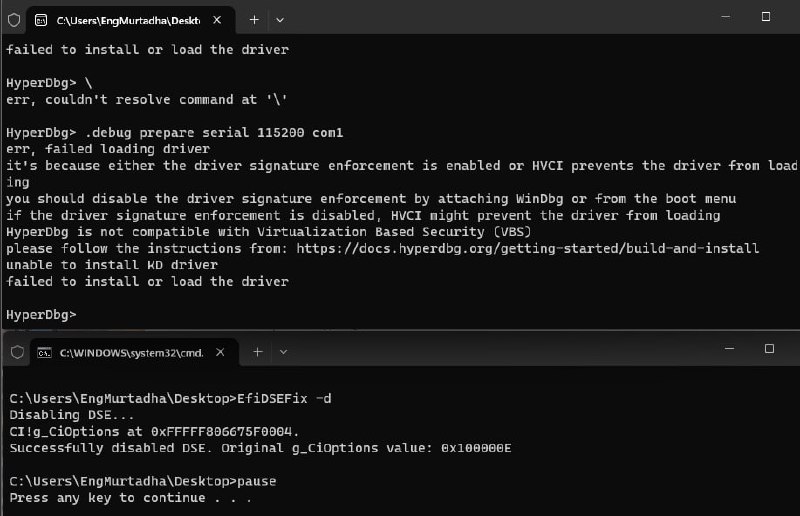
but when using this command ".debug prepare serial 115200 com1" directly BSOD with the error code DRIVER_IRQL_NOT_LESS_OR_EQUAL
I used Hyperdbg lasts beta also 0.18.1 same problem for both also try .connect local but when load vmm same issue
the processor is Intel Core i7 -
@HughEverett
Coming from github -
 Hey
Hey
What generation is your processor? -
12th Gen Intel(R) Core(TM) i7
-
Could you also test v0.20-beta?
https://github.com/HyperDbg/HyperDbg/releases/tag/v0.20-betaRelease v0.20-beta · HyperDbg/HyperDbgHyperDbg v0.20-beta is released! If you’re enjoying HyperDbg, don’t forget to give a star 🌟 on GitHub! Please visit Build & Install to configure the environment for running HyperDbg. Check out ...
-
Already test both
0.20-beta
0.18.1
same problem -
Could you connect to a windbg using kdnet? I might be able to help if I could have the results of '!analyze -v'.
-
Generally a 12 gen core processor should work unless there is a bug or the UEFI firmware behaves weirdly once configuring memory mapped regions.
-
I will try.
-
Also, before you try, could you please test the latest version of the 'dev' branch too? You can compile it using VS2026 but if you don't have Visual Studio setup, you can download the CI/CD artifacts from here:
https://github.com/HyperDbg/HyperDbg/actions/runs/28387577701Fix concatenation error for hyperkd string on the hypertrace project · HyperDbg/HyperDbg@2b0cc18State-of-the-art native debugging tools. Contribute to HyperDbg/HyperDbg development by creating an account on GitHub.
-
There is a small change in the loading of VMM which is fixed in the 'dev' branch, I suspect it might be the reason for the error.
-
I have the 2022 version and it does not have the full requirement
-
You can use github artifact files.
-
On it
-
I got this error when trying without disable the DSE
But after disable the same problem happened -
this is the dev version
-
Okay, the only way is too know what is happening there. We need result of '!analyze -k' from windbg.
-
you want first to connect through windbg live mode
or use the crash memory dump ?? -
Windbg over kdnet is preferred.
-
Break instruction exception - code 80000003 (first chance)
Unable to load image hyperhv.dll, Win32 error 0n2
hyperhv+0x1299:
fffff800`44061299 cc int 3
0: kd> !analyze -k
Connected to Windows 10 26100 x64 target at (Wed Jul 1 15:48:55.460 2026 (UTC + 3:00)), ptr64 TRUE
Loading Kernel Symbols
...............................................................
................................................................
................................................................
.........
Loading User Symbols
.................................
Loading unloaded module list
.........
Unable to load image \??\C:\Users\jonny\Desktop\release\hyperhv.dll, Win32 error 0n2
Unknown option '-k'
*******************************************************************************
* *
* Bugcheck Analysis *
* *
*******************************************************************************
Unknown bugcheck code (0)
Unknown bugcheck description
Arguments:
Arg1: 0000000000000000
Arg2: 0000000000000000
Arg3: 0000000000000000
Arg4: 0000000000000000
Debugging Details:
------------------
BUGCHECK_CODE: 0
BUGCHECK_P1: 0
BUGCHECK_P2: 0
BUGCHECK_P3: 0
BUGCHECK_P4: 0
PROCESS_NAME: hyperdbg-cli.exe
ERROR_CODE: (NTSTATUS) 0x80000003 - {EXCEPTION} Breakpoint A breakpoint has been reached.
SYMBOL_NAME: hyperhv+1299
MODULE_NAME: hyperhv
IMAGE_NAME: hyperhv.dll
FAILURE_BUCKET_ID: 0x0_hyperhv!unknown_function
FAILURE_ID_HASH: {c999474f-51ff-f2c4-4b94-1233318d2035}
Followup: MachineOwner
--------- -
Oh okay, this one is probably easy to understand (find) the error.
-
Since it is within the hyperhv module (not in a random place).
-
Could you please load the pdb files (pdb file of hyperhv) so windbg could map hyperhv+1299 to the function name.
-
SYMBOL_NAME: hyperhv!AsmVmxSaveState+29
MODULE_NAME: hyperhv
IMAGE_NAME: hyperhv.dll
STACK_COMMAND: .process /r /p 0xfffff802769cef00; .thread /r /p 0xffff9a8d0a7bd080 ; kb
BUCKET_ID_FUNC_OFFSET: 29
FAILURE_BUCKET_ID: 0x0_hyperhv!AsmVmxSaveState -
now send the result of this in windbg:
u hyperhv!AsmVmxSaveState+29 -
1: kd> u hyperhv!AsmVmxSaveState+29
hyperhv!AsmVmxSaveState+0x29 [D:\a\HyperDbg\HyperDbg\hyperdbg\hyperhv\code\assembly\AsmVmxContextState.asm @ 39]:
fffff802`0dde1299 cc int 3
fffff802`0dde129a eb00 jmp hyperhv!AsmVmxRestoreState (fffff802`0dde129c)
hyperhv!AsmVmxRestoreState [D:\a\HyperDbg\HyperDbg\hyperdbg\hyperhv\code\assembly\AsmVmxContextState.asm @ 48]:
fffff802`0dde129c 4881c400010000 add rsp,100h
fffff802`0dde12a3 415f pop r15
fffff802`0dde12a5 415e pop r14
fffff802`0dde12a7 415d pop r13
fffff802`0dde12a9 415c pop r12
fffff802`0dde12ab 415b pop r11 -
and this:
hyperhv+1299 -
it should be the same ??
-
1: kd> u hyperhv+1299
hyperhv!AsmVmxSaveState+0x29 [D:\a\HyperDbg\HyperDbg\hyperdbg\hyperhv\code\assembly\AsmVmxContextState.asm @ 39]:
fffff802`0dde1299 cc int 3
fffff802`0dde129a eb00 jmp hyperhv!AsmVmxRestoreState (fffff802`0dde129c)
hyperhv!AsmVmxRestoreState [D:\a\HyperDbg\HyperDbg\hyperdbg\hyperhv\code\assembly\AsmVmxContextState.asm @ 48]:
fffff802`0dde129c 4881c400010000 add rsp,100h
fffff802`0dde12a3 415f pop r15
fffff802`0dde12a5 415e pop r14
fffff802`0dde12a7 415d pop r13
fffff802`0dde12a9 415c pop r12
fffff802`0dde12ab 415b pop r11 -
yes
-
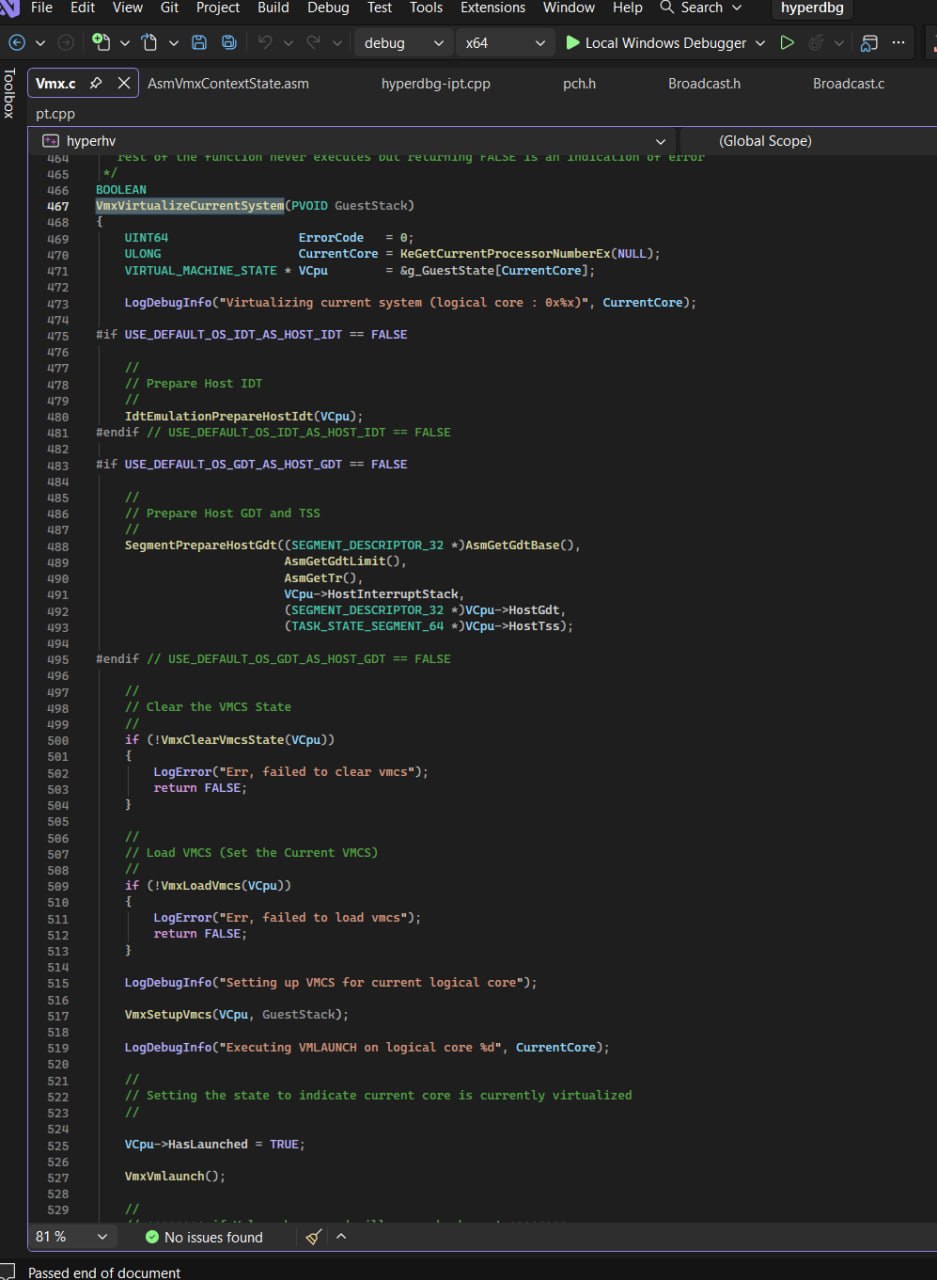
okay, for some reasons 'VmxVirtualizeCurrentSystem' failed.
-
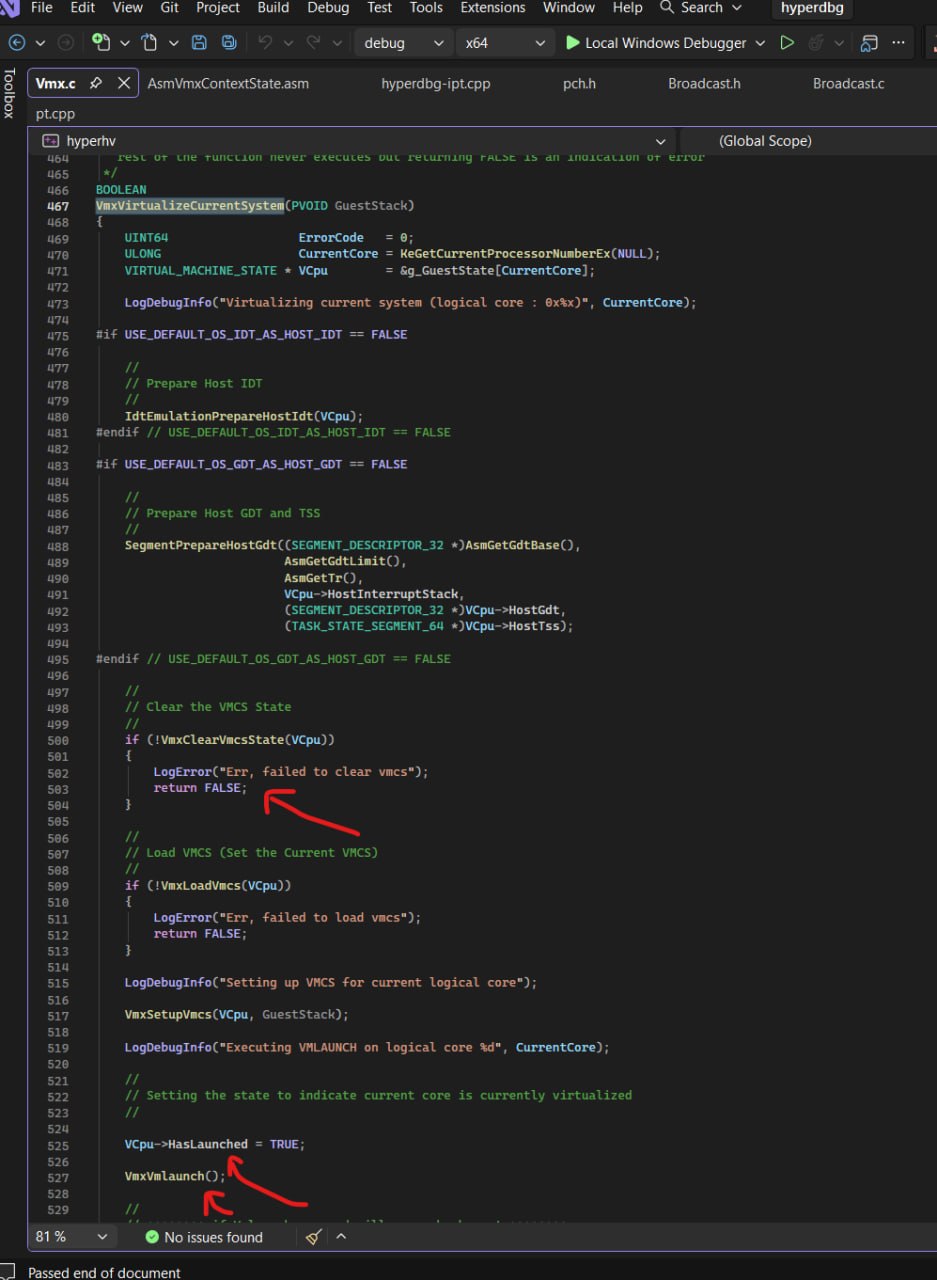
Could you put several DbgBreakPoint(); in these locations? I wanna see why it returns FALSE.
-
-
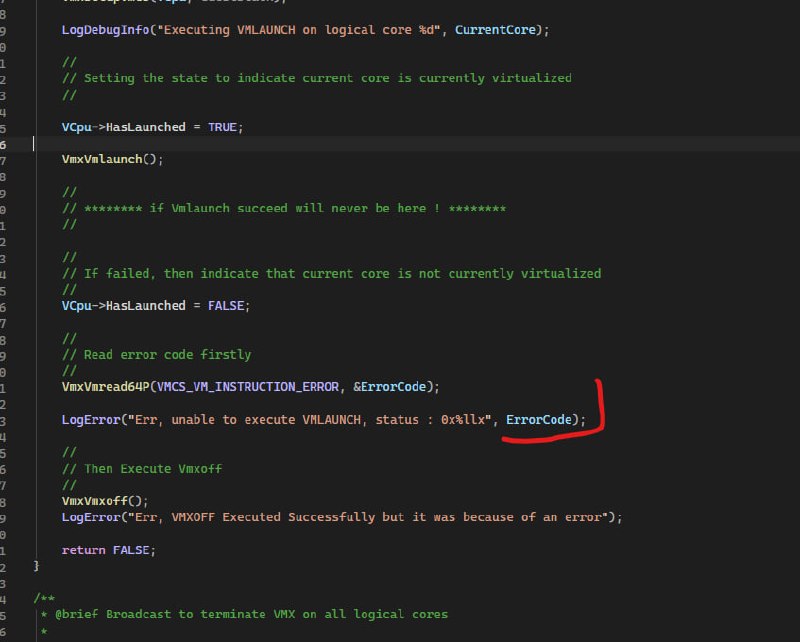
I think the code should be failed here, if that's the case, please put another breakpoint here and read the 'ErrorCode' so we could understand why you couldn't execute the VMLAUNCH instruction.
-
Feel free to use old versions (v0.18 source code with VS2022) to compile it.
-
 Literally remote kernel debugging
 -
Couldn't build it
Thank you for your time -
👍
- 03 July 2026 (6 messages)
-
Hi
I used the dev version with windows 10 it works fine
the problem was with the windows 11. -
 Hi
Hi
Maybe the reason was Windows SDK -
 Joined.
 -
Hello @PrefetchW
-
Hi aramando
-
Thank you for the warm welcome ❤️
- 04 July 2026 (1 messages)
-

- 05 July 2026 (1 messages)
-
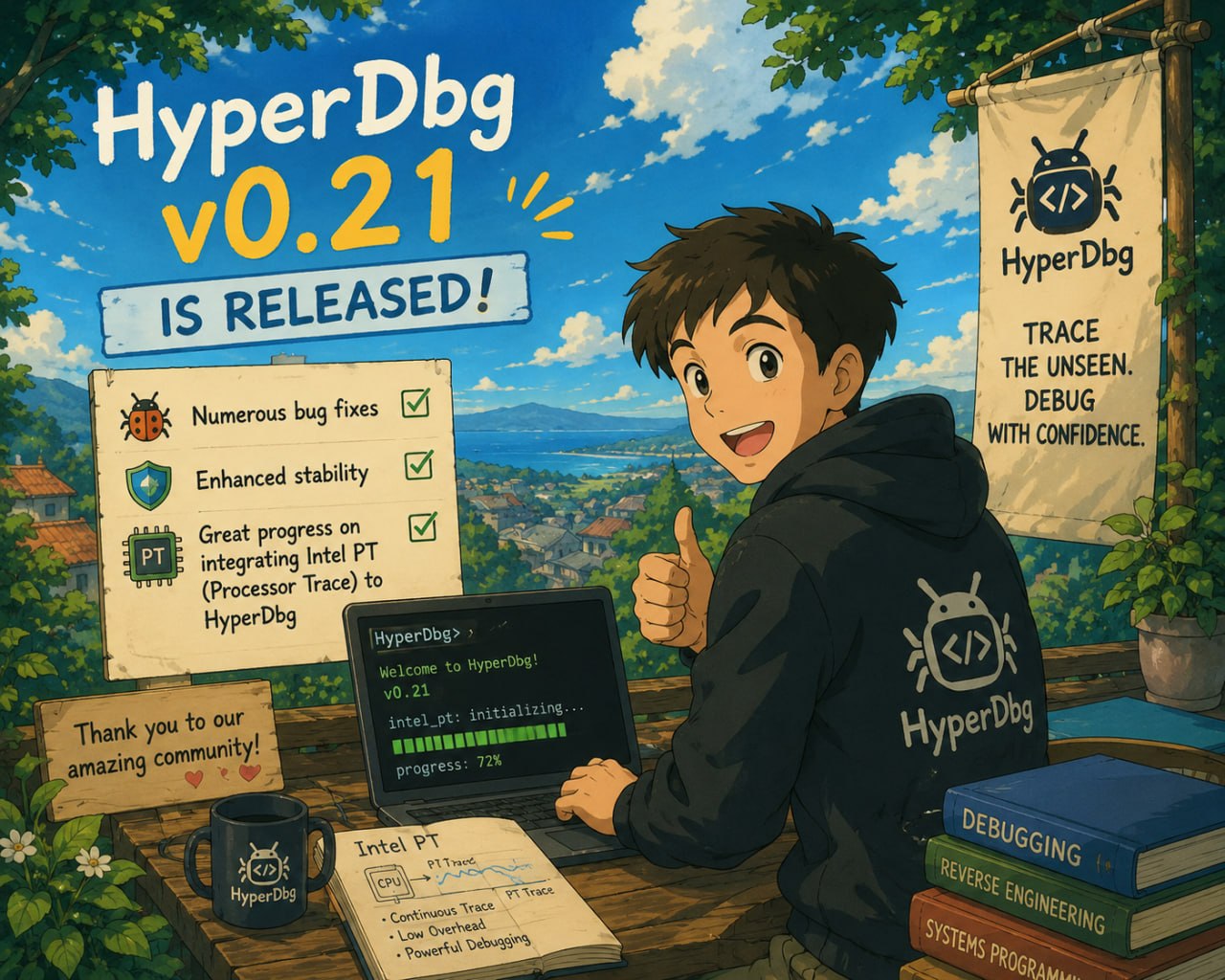
 HyperDbg v0.21 is released! 🪐💫
This release includes numerous bug fixes, improved stability, and significant progress toward integrating Intel PT (Processor Trace) into HyperDbg.
Check it out:
https://github.com/HyperDbg/HyperDbg/releases/tag/v0.21 - 08 July 2026 (1 messages)
-
Joined.
- 09 July 2026 (1 messages)
-

- 10 July 2026 (4 messages)
-
Does hyperdbg now support debugging using the intel pt mechanism?
-
It's not fully supported yet but just in case if you want to test it, you can use the following command:
!pt enable path "c:\programs\my exe file.exe" size 0x200000 core 3 -
But just keep in mind, other parameters of the '!pt' command are not yet done, only the 'enable' and the 'path' params are working.
-
 Joined.
 - 12 July 2026 (9 messages)
-
Which is better for debugging a hypervisor driver, windbg or Visual studio?
-
does the hypervisor driver load dlls into the kernel space?
-
 [discord] <unrustled.jimmies> what do you mean by windbg or visual studio?
 -
as I understand it, the classic way to debug a driver is with windbg. But it is possible to debug directly in the visual studio window, as if it were a user application
-
 Joined.
 -
AFAIK, their core debuggers are the same (they both use WinDbg routines embedded in the kernel).
-
Need to debug interrupts, faults, or exceptions? HyperDbg has plenty of commands to help!
Use !exception to intercept exceptions (the first 32 entries of the IDT) and !interrupt to intercept interrupts (IDT entries 32–255).
You can also step through ISR instructions, inspect the IDT with !idt, and explore the Local APIC and I/O APIC state in both xAPIC and x2APIC modes using !apic and !ioapic.
If you want to create (inject) artificial interrupts, HyperDbg provides a variety of functions for that as well.
Check it out:
!exception:
https://docs.hyperdbg.org/commands/extension-commands/exception
!interrupt:
https://docs.hyperdbg.org/commands/extension-commands/interrupt
!idt:
https://docs.hyperdbg.org/commands/extension-commands/idt
!apic:
https://docs.hyperdbg.org/commands/extension-commands/apic
!ioapic:
https://docs.hyperdbg.org/commands/extension-commands/ioapic
Functions:
- event_inject: https://docs.hyperdbg.org/commands/scripting-language/functions/events/event_inject
- event_inject_error_code: https://docs.hyperdbg.org/commands/scripting-language/functions/events/event_inject_error_code -
it sucks ass. almost nobody does it
-
use windbg itself
- 13 July 2026 (2 messages)
-
and what about this part?
-
 Joined.
 - 14 July 2026 (20 messages)
-
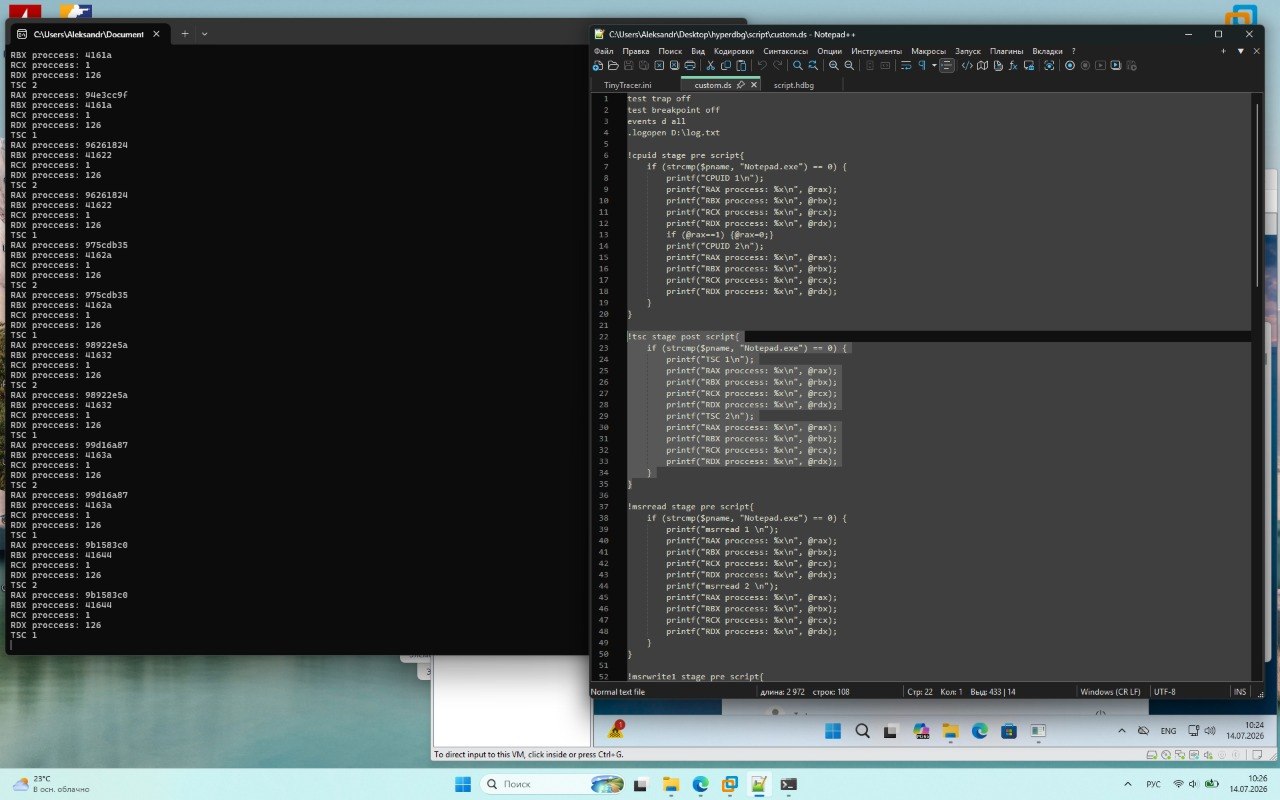
there is a problem with rdtsc - hyperdbg hanging.... But cpuid working is done. !msrwire and !ioin also cause problems.
-
@HughEverett
-
Is there any specific type of crash? or just it is hanging?
-
The output to the console goes non-stop... the command used in notepad.exe
-
I see, so technically you are flooding HyperDbg with events in which HyperDbg couldn't service a 'CTRL+C'. If it's the case, couldn't you use conditional statement (if else) to remove a certain number of generated events?
-
but...
!tsc stage post script{
if (strcmp($pname, "Notepad.exe") == 0) {
printf("TSC 1\n");
printf("RAX proccess: %x\n", @rax);
printf("RBX proccess: %x\n", @rbx);
printf("RCX proccess: %x\n", @rcx);
printf("RDX proccess: %x\n", @rdx);
printf("TSC 2\n");
printf("RAX proccess: %x\n", @rax);
printf("RBX proccess: %x\n", @rbx);
printf("RCX proccess: %x\n", @rcx);
printf("RDX proccess: %x\n", @rdx);
}
}
I already use the if then block to get tsc only for a specific exe... -
cpuid is working fine:
!cpuid stage pre script{
if (strcmp($pname, "Notepad.exe") == 0) {
printf("CPUID 1\n");
printf("RAX proccess: %x\n", @rax);
printf("RBX proccess: %x\n", @rbx);
printf("RCX proccess: %x\n", @rcx);
printf("RDX proccess: %x\n", @rdx);
if (@rax==1) {@rax=0;}
printf("CPUID 2\n");
printf("RAX proccess: %x\n", @rax);
printf("RBX proccess: %x\n", @rbx);
printf("RCX proccess: %x\n", @rcx);
printf("RDX proccess: %x\n", @rdx);
}
} -
The rate of execution of RDTSC/RDTSCP is usually very high.
-
and by default, even if you specify process ID it has a system-wide effect meaning that RDTSC/RDTSCP will cause VM-exit on all cores and all processes.
-
The problem with RDTSC/RDTSCP is that emulating them will cause a lot of trouble for the system sicne it breaks some of system's functionalities.
-
and for this case it will cause VM-exit on all processes and HyperDbg only filters it based on your provided PID (software filtering).
-
One suggestion that I have for this is that you can make it per process (create VM-exit only on that specific process while remaining without VM-exit on other processes). For implementing it this way, one option that you have is that you can use the same functionality that we have for the '!mode' command to filter based on CR3. Take a look at the implementation of the '!mode' command and use the same implementation to activate and deactivate RDTSC/RDTSCP exiting.
-
This way, only when CR3 is changed and reached to your target process, it activates RDTSC/RDTSCP exiting and once it context switches to another process, it won't cause VM-exit again.
-
I think if you look at the source code for the '!mode' command you'll understand how you could modify it but in case if you didn't understand any part feel free to send it here so I could help.
-
how would you catch tsc for a specific process (notepad.exe), and what command would you use?
-
I mean the idea is that we cause VM-exits for all Mov-to-CR3-exiting events, and once the target process is reached (at the change of the CR3), you can check for the process id (or process name) and decide whether to enable or disable RDTSC/P exiting from the control registers within VMCS.
-
If I say I need to track all rdtsc for notepad.exe, how can I do it without getting into the hypervisor code?
-
I think it needs hypervisor code modifications.
-
Otherwise it will cause VM-exit on all processes.
-

- 15 July 2026 (28 messages)
-
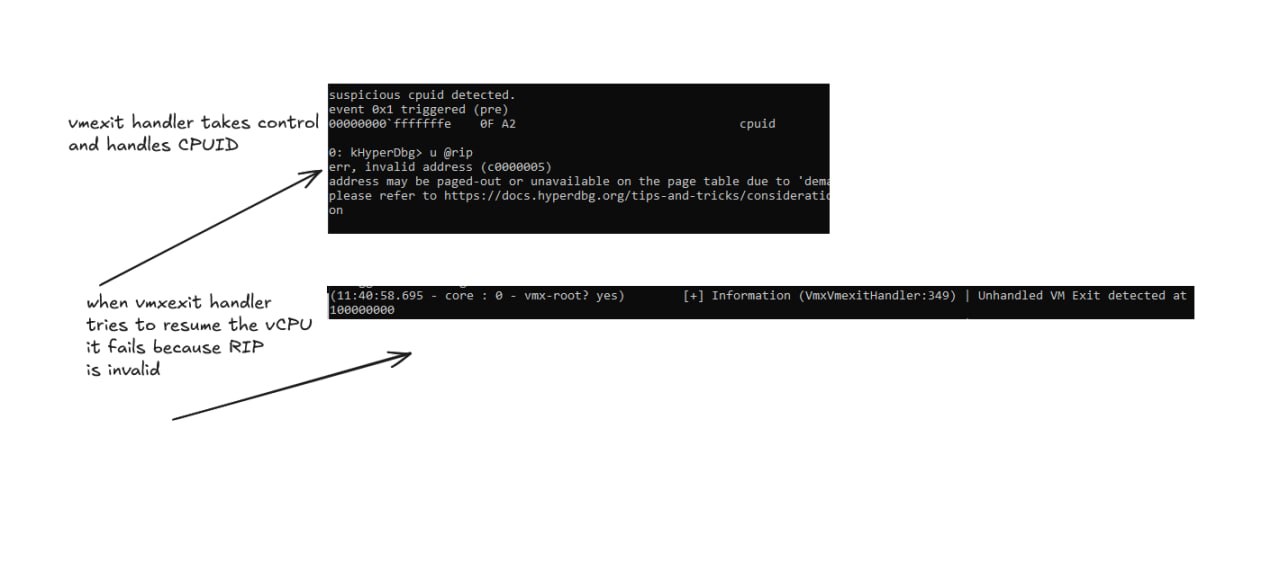
 hey so I have this program that allocates a custom payload at the end of a mapped view that triggers a vmexit via cpuid and makes hyperdbg get stuck in vmx root mode because RIP is invalid (it's outside of the page).
the payload is inside of a mapped view allocated at 0x0000fffd0000 and the cpuid (which triggers the vmexit) is at 0x0000ffffffffe
i was unable to find a workaround to this. All I could do is just make the program not jump to that payload.
My question here was, is this worth even "fixing" or is it up to me, as the user, to find my own ways? (just like I described above)
thanks for your attention! -
Hey,
I'm not sure if I understand the scenario. Are you trying to block the execution at a certain point and then depend on the continuation to the execution of a cpuid? -
The cpuid executes -> VMExit handles it -> It can't go resume execution because the address pointed to by RIP is invalid
-
Result: hypervisor halts and never leaves vmx root mode
-
So you are changing the RIP?
-
I don't understand why CPUID handler should break the RIP.
-
It's not the CPUID handler, it's the VMExit handler that can't resume execution because the next instruction doesn't exist
-
I'll make an illustration, one sec
-
I see. But then it should a create a page-fault, and OS should handle it, not HyperDbg.
-
Yes, that's what should happen but the thing is, HyperDbg is unable to get back to non root so the OS handles the page fault
-
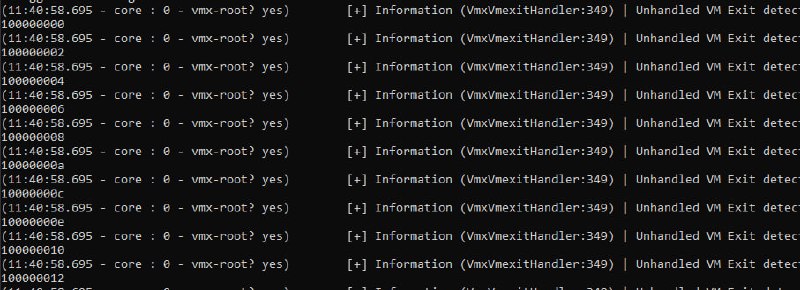
Is there any error or something? Like an unhandeled VM-exit after it happens?
-
yes
-
one moment ill replicate it
-
Because, VM-exit handler of CPUID as far as I remember doesn't have to do anything with the next instruction (but I might be wrong).
-
basically the processor performs its guest area checks and it throws an error
-
👍
-
A guest state invalid VM-exit?
-
sort of
-
wait im making the illustration
-
I tried to print the contents of RIP to show you it's invalid
-
this is the script I made to catch the malicious cpuid "!cpuid pid $arg1 script {
if (@eip > 0xffff0000)
{
printf("suspicious cpuid detected.\n");
pause();
}
}" -
I assume it goes unhandled because it's a guest area check error
-
also forgot to mention
-
as a result it keeps trying to resume execution by incrementing RIP but fails infinitely
-
I see. Do you happen to have a PoC for generating such a behavior so we can test a HyperDbg patch based on the PoC? Ideally a small C code that could generate this behavior.
-
Sorry for the late response. I'm not home right now and I will work on it as soon as I can
-
This behavior comes from a program that's not mine
-
But sure I'll write a PoC
- 16 July 2026 (22 messages)
-
[discord] <unrustled.jimmies> [reply]: Yeah this looks like a hypervisor detection check where it switches the cpu to be in compatibility mode and execute a vmexit instruction at max eip so eip overflows per arch but hv just increments it as if it was a 64bit number.
"a program that's not mine", is it an anticheat? -
no it's protected malware
-
[discord] <unrustled.jimmies> can you send me the bin?
-
you'll get a PoC just wait
-
That would be great. Thanks.
-
You know what? I'm thinking that the same behavior might happen in other conditional/non-conditional VM-exits too. 🤔
-
We could mitigate it for the CPUID but it might be a little bit overkill if we add checks to read the next running instruction in all VM-exits as it might add a considerable overhead to the VM-exit handler.
-
Or maybe even a better solution would be to make these checks whenever Invalid Guest State VM-exit is thrown.
-
@itshopelesshopeless
I made a patch for this. Could you test it and verify if it fixes the problem?
(Thanks to a community member for sending mentioning this solution ❤️)
https://github.com/HyperDbg/HyperDbg/commit/90c1513adb7a83bfb3a1f622130748b9deb2c34e -
If you couldn't build it, you can use GitHub built artifacts here:
https://github.com/HyperDbg/HyperDbg/actions/runs/29527259427fix checks for long mode if RIP is overflown · HyperDbg/HyperDbg@90c1513State-of-the-art native debugging tools. Contribute to HyperDbg/HyperDbg development by creating an account on GitHub.
-
sorry I couldn't write a PoC in time. I should've done that from the beginning
-
no problem. if you could just test this patch that would be fine too.
-
sure
-
thanks
-
it works
-
you mean the problem is solved?
-
yeah no halts
-
vm is resumed and the page fault exception gets caught
-
great
-
So, I worked on it a little. I thought that adding this check to all VM-exits (that require a VMRESUME) might be overkill and cause a performance penalty for a scenario that might only occur if anti-debugging or hypervisor evasion methods are present. To avoid incurring this cost by default in HyperDbg, I thought it might be better to move the mitigation for this technique to the HyperEvade project instead.
-
So, here it is, if you want to use it in the future, you could enable HyperEvade:
https://github.com/HyperDbg/HyperDbg/commit/14e7d88c3c05c5cde7d51c87b5ecd5d9ce5e5af5add fix non long mode RIP overflow to the hyperevade project · HyperDbg/HyperDbg@14e7d88State-of-the-art native debugging tools. Contribute to HyperDbg/HyperDbg development by creating an account on GitHub.
-
That's great.
- 17 July 2026 (1 messages)
-
Joined.
- 18 July 2026 (2 messages)
-
 Joined.
 -
 Joined.
 - 19 July 2026 (9 messages)
-
 Joined.
 -
Hey all 👋 came across an issue similar to #30 (DRIVER_IRQL_NOT_LESS_OR_EQUAL when reading registers after a break in Debugger Mode) and managed to track it down and get it working on my setup, so I've opened a PR: https://github.com/HyperDbg/HyperDbg/pull/648 🙂Fix DRIVER_IRQL_NOT_LESS_OR_EQUAL when reading registers on a manually-halted core by munraimix · Pull Request #648 · HyperDbg/HyperDbg
Problem In Debugger Mode, breaking the debuggee (Ctrl+C) and then reading registers (e.g. the r command) can bugcheck the debuggee with DRIVER_IRQL_NOT_LESS_OR_EQUAL (0xD1) at IRQL 0xff. This match...
-
Hey,
Cool. I'll review it later today. 👍 -
And will come back to have if I have any question about this PR.
-
Okay, I went through this issue. First of all, thanks really. It was a really hidden problem, and I see now what you mean, so thanks for putting time and effort into fixing it. I merged your PR. However, I think it is more fundamental than we thought.
-
The problem is that we are using two references for 'regs'. I initially thought this might be a silly idea, as we could simply query the guest registers from the VMX code and completely remove the need for a second reference to the guest registers (just as you did). However, this assumption does not work in certain locations, such as !epthook2, which basically runs everything from VMX non-root mode. Because of this, I created another PR to remove the reference to the guest registers in the debugger (and also replaced some of your code). I believe this approach will prevent possible future errors since we will have only one place for storing and using registers and fundamentally solves this issue.
-
@HumbleMuns I would appreciate it if you could check and test this PR (merged into the dev branch) and tell me if it works (and fixes the problem) or not: https://github.com/HyperDbg/HyperDbg/commit/d37352fd7ee3b7c9a4a5383c847f210dc6c3d716
-
Yes, I would like to refine this approach into a stable model.
The core idea is not to let the reader determine which process is accessing the target page at read time. Instead, the reader should use a separate address translation path prepared in advance:
Target process VA
-> target guest PFN G0
-> EPT
-> fake host PFN F
Reader VA
-> alias guest PFN G1
-> EPT
-> original host PFN O
The most important point is that the reader’s PTE must not continue pointing to the target’s original guest PFN, G0. Once G0 has been redirected to the fake page through EPT, any access through G0 will also reach the fake page.
The reader must therefore point to a new alias guest PFN, G1, while EPT maps G1 to the real original backing page.
The proposed design is as follows.
1. Prepare an alias guest PFN for every payload page
The most stable option may be to allocate and lock one page of nonpaged physical memory and use it as a placeholder PFN.
For example:
G1 = guest PFN of the alias placeholder page
The original contents of this page are irrelevant. Its purpose is simply to provide a valid PFN that Windows and the reader’s PTE can reference.
2. Create two stable EPT mappings
G0 -> fake PFN, R/W/X
G1 -> original PFN, read-only, X=0, W=0
With this arrangement, the target process always sees the fake page and can read, write, and execute it without generating frequent traps.
The reader accesses only its own alias VA and therefore always sees the original page.
3. Modify the reader’s VA or PTE mapping
When the reader uses a fixed kernel virtual address:
reader_va PTE.PFN = G1
When the reader dynamically maps physical pages, the mapping path must be modified so that it maps G1 instead of G0.
4. Handle synchronization correctly
After modifying the reader’s PTE, the TLB entry for the reader’s virtual address must be invalidated.
After changing EPT mappings, INVEPT must be performed.
The cache type must also remain consistent with the original page. The same host physical page should not be aliased through incompatible memory-cache attributes.
5. The following validation matrix must pass
Target reads G0 -> fake page
Target writes G0 -> fake page
Target executes G0 -> fake page
Reader reads reader_va/G1 -> original page
High-frequency reader access -> no increase in EPT violations
Target writes do not modify the original page
Failure handling should also be strict. If the reader alias cannot be created, or if the reader is detected pointing to G0 again, the system must not report that initialization completed successfully.
Once the reader’s PTE points to G0, EPT will redirect its access to the fake page as well.
In summary, EPT provides two fixed mappings:
G0 -> fake
G1 -> original
The reader is separated through its PTE or mapping path:
The reader never accesses G0. It accesses only G1.
This should be more suitable for high-frequency access than switching EPTPs or handling every read through EPT violations.
Could experienced developers please comment on whether this design is realistically implementable?
This proposed solution was generated with the help of AI, so I would especially appreciate feedback about any incorrect assumptions involving Windows PFN management, PTE modification, EPT aliasing, TLB invalidation, cache attributes, or page lifetime management.
My actual goal is to make a particular kernel module always receive a specified value when it reads a certain memory address, while normal execution, reads, and writes through that memory address continue to observe a different value.
I am not looking for a design that triggers an EPT violation on every access. In my current high-frequency scenario, trap-based EPT handling causes severe performance problems and may freeze the system. The requirement is therefore a stable dual-view mapping with no per-read trapping on the normal access path. -
@HughEverett Help me out, pro.
- 20 July 2026 (20 messages)
-
your message is longer than my physics exam lecture
-
Tested your dev commit on bare metal (Intel 9th gen, Win11 24H2, serial debugger mode). Break then r now returns the registers fine, no more 0xD1, and g continues cleanly too. Confirmed fixed on my hardware. Thanks for sorting it so quick, and nice call collapsing it down to one reg reference.
-
HyperDbg v0.22 is released! 💫
Apart from bringing bug fixes, major progress toward porting HyperDbg for #Linux, HyperDbg now supports structures in the script engine.
This version also introduces new commands to display linked lists.
Check it out:
https://github.com/HyperDbg/HyperDbg/releases/tag/v0.22
For more information,
Check structures in the script engine:
https://docs.hyperdbg.org/commands/scripting-language/structures-and-arrays#structures
displaying linked lists in the virtual memory:
https://docs.hyperdbg.org/commands/debugging-commands/dl
And physical memory:
https://docs.hyperdbg.org/commands/extension-commands/dlRelease v0.22 · HyperDbg/HyperDbgHyperDbg v0.22 is released! If you’re enjoying HyperDbg, don’t forget to give a star 🌟 on GitHub! Please visit Build & Install to configure the environment for running HyperDbg. Check out the Q...
-
I'll get back to you later today.
-
great. thanks
-
This release wouldn't have been possible without the help and outstanding work of @xmaple555, @maxraulea, @Ablfzl4m , and @HumbleMuns .
-
 Thanks, Sina, for giving me this opportunity.❤🙏
 -
Thanks to you for all your great works ❤️
-
I read this idea; honestly, I'm not sure if I understand it quite accurately. In case you want to have a page with Execute-only permissions while providing read and write access to a different value, isn't that the same as what HyperDbg does with '!epthook'?
Basically, there is a breakpoint while the process is executing, but if the process or kernel wants to read it, there is nothing there.
By the way, I might be inaccurate. If that's the case, could you elaborate more on that? -
 Can HyperDbg automatically bypass common anti-VM checks like CAPE does, or is that something the analyst has to implement manually?
 -
as far as I see yes some: https://github.com/HyperDbg/HyperDbg/blob/056793954e876d6f127c0ff5cc52cb84c053c9d6/hyperdbg/hyperevade/header/SyscallFootprints.hHyperDbg/hyperdbg/hyperevade/header/SyscallFootprints.h at 056793954e876d6f127c0ff5cc52cb84c053c9d6 · HyperDbg/HyperDbg
State-of-the-art native debugging tools. Contribute to HyperDbg/HyperDbg development by creating an account on GitHub.
-
@HughEverett Thank you so much for your answer. This is a bit different from EPT. EPT involves canceling one of the three rwx permissions on a page, which causes an exception
-
But it directly modifies your mapped memory address pointer
-
Maybe I got it wrong? From what I found out, that's just how it seems to be?
-
anyone know a good forum software?
-
xenforo maybe
-
[discord] <tallylc> Hello All, I have just come across HyperDbg and am looking forward to experimenting with it. Looks like I have to disable the VBS on my Windows 11 (x64) first.
-
[discord] <rayanfam> [reply]: yes, you can follow instructions here: https://docs.hyperdbg.org/getting-started/build-and-installBuild & Install | HyperDbg Documentation
This document helps you to build and install HyperDbg
-
maybe
-
[discord] <tallylc> [reply]: Thanks and i am working on making the changes to my Windows 11 (x64). I also had a question in wondering if there were plans to make a UEFI bootable version that could have nested virtualization so that you would not have to go through all of the configuration changes?
On that note, there is an interesting project called Bitvisor (https://www.bitvisor.org/en/) that I have played with a bit in the past and although it is not a debugger, it is a type of Para- passthrough hypervisor that can coexist with Hyper-V. Just my thoughts on things so far but have to admit that what i have seen and learned so far in the videos about HyperDbg is really awesome and your team has done an amazing job. 🙂 - 21 July 2026 (15 messages)
-
You're right. Yes, in that case, it could be useful, and it is also possible to implement it with the least modification to the HyperDbg core if you want to use HyperDbg as the baseline.
-
[discord] <rayanfam> [reply]: Thanks 🙏. Yes it's possible to release HyperDbg as a UEFI module and support nested virtualization.
-
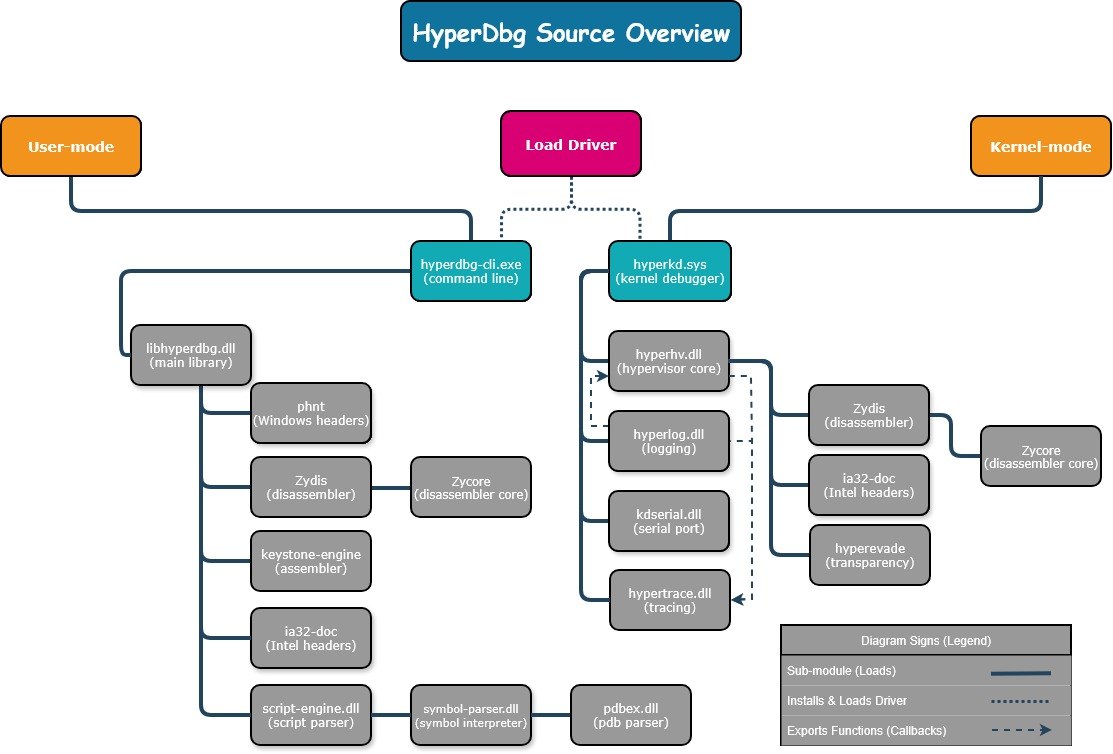
[discord] <rayanfam> [reply]: This is also in the todo list, hopefully we could reach to it in the future. Right now, we are actively working on porting HyperDbg to Linux, enhancing hypertrace project (for supporting Intel PT) and improving hyperevade project for anti-anti-debug and hypervisor methods.
-
-
[discord] <unrustled.jimmies> [reply]: > nested virtualization
debugging hyperv with hyperdbg coming soon 👀 -
[discord] <rayanfam> [reply]: Not really planned for now. It is just in the todo list. Might take years to come unless we find someone interested in implementing that. 🙂
-
 I'll take it if I'm laid off soon ;)
 -
[discord] <unrustled.jimmies> haha yeah ik, having nested virtualization that can boot another bluepill style hv is totally different than being able to boot hyperv under it.
-
Then I hope you get laid off soon. 😅😉
-
Thanks mate :D
-
Sure thing 🫡
-
[discord] <tallylc> [reply]: Any projections on the Linux version. Mostly just wondering?
-
[discord] <rayanfam> [reply]: @maxraulea is leading this project. He is more informed about the current state.
-
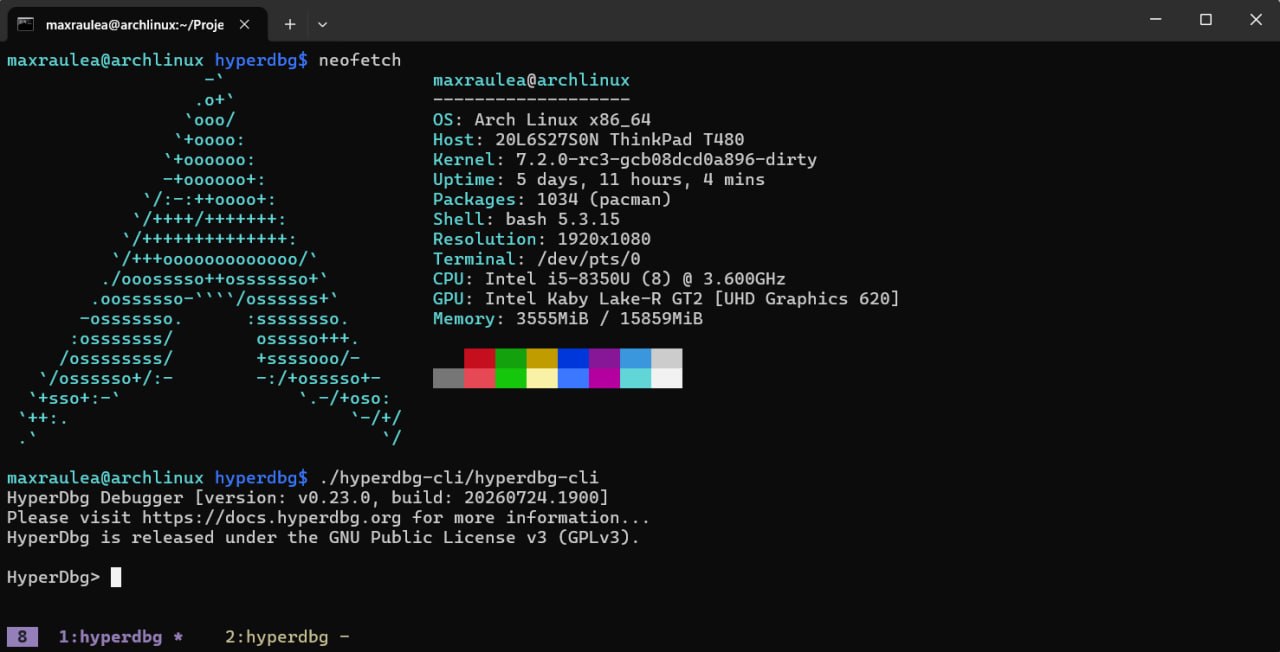
[discord] <maxraulea> [reply]: Rn we are just getting to a compiled version with stubs for some OS specific parts, the user space lib (libhyprdbg) almost compiles, a couple of files left. Then we will have to compile the kernel module and fill in the stubs for linux for the userspace
-
[discord] <rayanfam> [reply]: 👍 🫡
- 22 July 2026 (5 messages)
-
[discord] <q_iwirieow> hello
-
[discord] <q_iwirieow> is there an mcp server for hyperdbg
-
[discord] <q_iwirieow> gotta get claude up to skid
-
[discord] <jakob944> [reply]: wrong debugger
-
[discord] <q_iwirieow> [reply]: edited
- 23 July 2026 (8 messages)
-
HyperDbg doesn't have an MCP server yet 😞
-
A new command 'ucpuid' is added thanks to @anti_zealot :
https://docs.hyperdbg.org/commands/debugging-commands/ucpuid#commanducpuid (execute CPUID instruction in debuggee) | HyperDbg DocumentationDescription of the 'ucpuid' command in HyperDbg.
-
Feel free to test it, it's on the 'dev' branch now.
-
I appreciate you my brother, almighty God bless you 🙏✌️
-
[discord] <q_iwirieow> [reply]: do you know anything about this? its quite old
https://github.com/HyperDbg/mcpGitHub - HyperDbg/mcp: HyperDbg's MCP ServerHyperDbg's MCP Server. Contribute to HyperDbg/mcp development by creating an account on GitHub.
-
I don't think that it's on a working state.
-
But if you have any idea of writing an MCP server, let me know so we can host on the GitHub org. Basically it should be some AI generated MCP server.
-
[discord] <q_iwirieow> [reply]: Ok
- 24 July 2026 (1 messages)
-
 Joined.
 - 25 July 2026 (1 messages)
-
Joined.
- 26 July 2026 (6 messages)
-
I could probs have a look into this
-
I'll build something out and PR it
-
👍
-
Major milestone in bringing HyperDbg to Linux! 🐧
Huge thanks to @MaxRaulea, all HyperDbg user-mode modules now compile on Linux. 🎉🪐💫
Next step is porting the kernel modules... -
🔥🔥🔥
-
[discord] <q_iwirieow> get 3 opus 5 agents to make this shit work on amd
- 27 July 2026 (5 messages)
-
👍👍👍
-
Hey Sina, following up on your note about wanting an MCP server for HyperDbg. I built one and put it up here: https://github.com/munraimix/hyperdbg-mcp
It's a Python MCP server that drives HyperDbg through libhyperdbg over ctypes (no HTTP shim), so it gets the script engine and structured SDK calls, not just CLI text. Around 77 tools covering registers, memory, disassembly, breakpoints, events and hooks, paging, symbols, and the hardware SDK. Works in both local VMI mode and Debugger Mode (serial, named pipe, net), connects lazily so the agent attaches on demand, and ships a read-only mode plus a confirmation gate on anything that mutates the target. GPLv3 to match the rest of HyperDbg.
I've run it end to end on a real two-machine serial rig: connect, read ring-0 registers, disassemble at RIP, clean disconnect. Building it also surfaced a serial framing bug (the receiver floods and can wedge the driver after an unclean disconnect), so I opened a fix for that against dev: https://github.com/HyperDbg/HyperDbg/pull/663 (Fixes #661).
Happy to have the org host it however you prefer: transfer the repo, move it under HyperDbg/mcp, or use it as a base. Open to feedback on the tool design too. -
Hey,
Thank you very much.
I would appreciate if you could add it here:
https://github.com/HyperDbg/mcpGitHub - HyperDbg/mcp: HyperDbg's MCP ServerHyperDbg's MCP Server. Contribute to HyperDbg/mcp development by creating an account on GitHub.
-
And for the PR, yes, that's great. I saw it. I'll review it in the coming day and will merge it. Also do you have an example that I could create the issue that you mentioned for reproducing it?
-
Thanks again for all your efforts ❤️
- 28 July 2026 (6 messages)
-
Thanks Sina, really appreciate it 🙏
Done, I opened it as a PR into the org repo: https://github.com/HyperDbg/mcp/pull/1 (it swaps the old Go prototype for the Python server). Happy to adjust the structure, naming, or packaging to whatever you prefer.
For the serial bug, I'll get you a clean reproduction example this afternoon so you can spin up the issue and verify it easily.
And no rush on #663, thanks for taking a look 👍Python MCP server for HyperDbg (replaces the Go prototype) by munraimix · Pull Request #1 · HyperDbg/mcpPer @HughEverett's request in the HyperDbg group, this replaces the earlier (non-working) Go prototype with a working Python MCP server for HyperDbg. What it is A Model Context Protocol ser...
-
Reproduction is up on the issue: https://github.com/HyperDbg/HyperDbg/issues/661#issuecomment-5103311367
Good news is it needs no driver, no test-signing and no hypervisor, since the debuggee runs its handshake loop before the module is loaded. So one machine with a com0com pair is enough: `.debug prepare serial 115200 com10` on one end, then write a continuous stream of marker-free bytes to the other end.
I ran it against both builds with the same 327680 bytes. On dev it prints the "exceeds the buffer limitation" plus "invalid buffer received" pair once per 81920 bytes and the handshake retries stop. With #663 it prints one resync line and the handshake loop keeps running. Counts and the exact console output are in the comment.Debuggee floods "buffer exceeds the buffer limitation" and cannot resync after an unclean serial disconnect · Issue #661 · HyperDbg/HyperDbgComponent: hyperkd, hyperdbg/hyperkd/code/debugger/communication/SerialConnection.c (SerialConnectionRecvBuffer) Mode: Debugger Mode over serial Summary If the debugger side drops the serial link u...
-
[discord] <q_iwirieow> mcp server is such a good idea
-
[discord] <q_iwirieow> deadass
-
I see.
-
Great. Thanks
- 29 July 2026 (7 messages)
-
-
Joined.
-
hey, anybody have experience with debugger mode with two physical machines linked by serial link?
-
Are there good first issues or anything a newcomer could work on (who’s been using the tool for a bit)
-
Hey,
There was a discussion in the group about this in the past. It seems HyperDbg doesn't perform validation of packets, and since the serial port is prone to errors, it fails. So, I don't recommend using it at this stage. However, we have a contributor working on implementing Intel e1000 NICs. I don't know the current progress state, but I suppose it should be ready in the coming months, so I recommend waiting for it to debug a remote machine. -
Hey,
Nice that you want to work on HyperDbg. ❤️
Please check all todo lists here, and if you find any of them interesting or you need more explanation about any of them, mention it here so we can discuss about it:
https://github.com/orgs/HyperDbg/projects/2HyperDbg • HyperDbgHyperDbg features development progress
-
Thanks!!
- 30 July 2026 (2 messages)
-
Thanks for the info!
-
Joined.
- 31 July 2026 (1 messages)
-
Joined.

@hyperdbg / Public archive of HyperDbg Telegram messages.
- 01 Jul 2026 (40)
- 03 Jul 2026 (6)
- 04 Jul 2026 (1)
- 05 Jul 2026 (1)
- 08 Jul 2026 (1)
- 09 Jul 2026 (1)
- 10 Jul 2026 (4)
- 12 Jul 2026 (9)
- 13 Jul 2026 (2)
- 14 Jul 2026 (20)
- 15 Jul 2026 (28)
- 16 Jul 2026 (22)
- 17 Jul 2026 (1)
- 18 Jul 2026 (2)
- 19 Jul 2026 (9)
- 20 Jul 2026 (20)
- 21 Jul 2026 (15)
- 22 Jul 2026 (5)
- 23 Jul 2026 (8)
- 24 Jul 2026 (1)
- 25 Jul 2026 (1)
- 26 Jul 2026 (6)
- 27 Jul 2026 (5)
- 28 Jul 2026 (6)
- 29 Jul 2026 (7)
- 30 Jul 2026 (2)
- 31 Jul 2026 (1)